From $500K to $5M: The Complete Dubai Property Investment Roadmap for International Buyers
Description
Dubai is no longer simply a lifestyle destination. In 2026, it stands as one of the world’s most deliberate investment addresses — a city where international capital doesn’t just arrive, it stays, compounds, and exits cleanly.
In 2025 alone, Dubai’s residential property market recorded over AED 232 billion in transactions. Buyers from more than 160 nationalities purchased property here. Zero income tax. Zero capital gains tax. Zero property holding tax. Full freehold ownership for foreigners. A stable AED-USD peg. And one of the highest rental yields of any major global city.
But investing in Dubai without a proper roadmap is where most international buyers make mistakes — costly ones. The wrong developer, the wrong ownership structure, the wrong community, or the wrong entry timing can strip 2–3 years of returns before you’ve earned a dirham.
This guide exists to prevent that. Whether you are deploying $500,000 or $5 million, this is the complete, no-fluff roadmap — covering every step from investment thesis to Title Deed. Built for serious international buyers. Designed to get you from informed to invested, correctly.
Why Dubai? The Investment Case in 2026
Every serious investor asks the same question first: why Dubai, why now? The answer in 2026 is more compelling than it has ever been — and it rests on six structural pillars that no other major real estate market currently offers in combination.
1. Zero Tax Environment
The United Arab Emirates levies no income tax, no capital gains tax, no inheritance tax, and no property holding tax. Rental income earned on a Dubai property flows entirely to the investor. When you eventually sell, 100% of the capital gain is yours to repatriate. Compare this with London (up to 45% income tax on rental income), New York (combined federal and state tax near 50%), or Sydney (capital gains tax up to 23.5%) — and the arithmetic of Dubai’s tax advantage is immediate.
2. Gross Rental Yields That Rival Emerging Markets
Prime Dubai districts consistently deliver gross rental yields of 6–9%, significantly outperforming established global cities. London prime yields average 2.5–3.5%. Manhattan averages 3–4%. Singapore sits at 2.5–3%. Dubai’s higher yields are structural, not speculative — driven by a large transient expat population (over 88% of residents are non-nationals), high demand for furnished rental properties, and a culture that rents rather than owns.
3. Freehold Ownership for Any Nationality
Since 2002, Dubai has allowed full freehold property ownership by foreign nationals in designated freehold zones. This is unrestricted — you do not need to be a UAE national, a resident, or even present in the country to complete a purchase. You own the Title Deed outright, with the same legal protections as any citizen owner. There is no restriction on renting, renovating, selling, or passing the asset to heirs.
4. UAE Residency Through Property
Property investment unlocks one of the world’s most valuable residency programmes. Purchase above AED 750,000 and you qualify for a 2-year renewable investor visa. Purchase above AED 2,000,000 and you qualify for the UAE Golden Visa — a 10-year renewable residency that extends to your spouse, children, and domestic staff. The Golden Visa carries no minimum stay requirement and provides access to UAE banking, business licensing, healthcare, and education.
5. Population Growth That Is Structural, Not Speculative
Dubai’s population has grown from 1.9 million in 2012 to over 3.8 million in 2025 — and projections suggest 5.8 million by 2040. This growth is driven by deliberate government policy: economic diversification, business-friendly regulation, long-term visa reforms, and positioning the UAE as a global hub for finance, technology, and tourism. Growing population means growing rental demand, which is the most reliable foundation for sustained property yield.
6. World-Class Infrastructure With Continued Investment
Dubai International Airport remains the world’s busiest by international passengers. The Expo City development, the ongoing expansion of the metro network, the new Al Maktoum International Airport (projected to become the world’s largest), and over AED 50 billion in infrastructure commitments through 2030 create a virtuous cycle of connectivity, demand, and property value appreciation. Investing near announced infrastructure is one of the most reliable yield-enhancement strategies in Dubai’s market.
Understanding the Investment Tiers: $500K to $5M
Dubai’s property market is vast and stratified. Before examining specific steps or locations, it is essential to understand which investment tier aligns with your capital, return expectations, and personal goals. The following framework divides the market into three tiers, each with a distinct risk-return profile.
| Tier | Budget Range | Typical Property | Gross Yield | Best For |
| Entry | $500K – $1M | Studio / 1BR – JVC, Marina | 7% – 9% | Income investors |
| Mid-Tier | $1M – $2.5M | 2–3BR – Downtown, Business Bay | 6% – 8% | Yield + residency |
| Premium | $2.5M – $5M+ | Villas / Penthouses – Palm | 5% – 6% | Capital growth + lifestyle |
Entry Tier: $500,000 – $1,000,000
The entry tier is the highest-volume segment of Dubai’s international investor market, and for good reason. Studio and one-bedroom apartments in well-connected communities — Jumeirah Village Circle, Business Bay, Dubai Marina, and Arjan — are in constant demand from the city’s large professional expat base. Off-plan payment plans at this price point are exceptionally attractive: a typical structure requires 20% at signing, followed by 1% monthly during construction, with the balance at handover. This allows investors to deploy capital gradually rather than in a lump sum.
At the upper end of this tier, entry-level properties on Palm Jumeirah and select One Bedroom units in Downtown Dubai are within reach — and the brand premium of these addresses accelerates both rental rates and capital appreciation. Gross yields of 7–9% are regularly verified at this tier, and short-term rental income through DTCM-licensed holiday home operations can add 20–40% on top of equivalent long-term lease income.
Mid-Tier: $1,000,000 – $2,500,000
This is where Dubai’s market becomes truly exceptional by global standards. Two and three-bedroom apartments in Downtown Dubai, Business Bay, Dubai Marina, and Dubai Hills Estate represent the best balance of yield, liquidity, capital appreciation, and Golden Visa eligibility in the entire market. Properties at this tier attract premium tenant profiles — senior expat executives, diplomatic staff, and international families — who sign longer leases, cause lower tenant turnover, and maintain properties at a higher standard.
The AED 2,000,000 threshold (approximately $545,000 at current rates, meaning most properties in this tier qualify) unlocks the UAE Golden Visa — 10 years of renewable residency for you and your dependents, with no minimum stay requirement. For investors who want both yield and the option of a UAE base, the mid-tier delivers both simultaneously.
Premium Tier: $2,500,000 – $5,000,000+
At this level, the investment thesis shifts from yield to capital appreciation. Four and five-bedroom villas on Palm Jumeirah fronds, luxury penthouses in Downtown, waterfront villas in Jumeirah Bay Island, and branded residences bearing names like Armani, Bulgari, Bugatti, and W Hotels have delivered extraordinary capital appreciation — in some cases 40–50% above 2021 prices, with further upward momentum expected through 2027.
Rental yields compress at this tier (4.8–5.5% gross), but the absolute rental income figures are significant — well-positioned villas and penthouses can command AED 400,000–800,000 per year on long-term leases, and multiples of that on short-term luxury rental programmes. The primary return driver at this tier is capital appreciation, and the exit strategy demands a minimum 5–7 year hold horizon for maximum realisation.
The 7-Step Investment Roadmap
What follows is the precise sequence every serious international buyer should follow. Skipping steps or reordering them is where most costly errors occur.
STEP 1 · FOUNDATION
Define Your Investment Thesis
Before opening a single property listing, you need absolute clarity on three core decisions. First: your capital horizon. Are you seeking a short-term flip (24–36 months), a medium-term hold (3–7 years), or a permanent portfolio anchor? Second: your return priority. Is your primary goal rental income, capital appreciation, or a balanced combination of both? Third: your personal use case. Are you a pure investor seeking returns on deployed capital, or do you want the option to use the property personally — as a second home, a UAE base, or a residency anchor?
These three decisions are not interchangeable. They require fundamentally different property types, locations, and developer profiles. An income-focused investor in a 3-year horizon should be buying a ready one-bedroom in Business Bay with a DTCM holiday home licence — not an off-plan villa in a community delivering in 2028. Clarity on thesis prevents the single most common mistake: buying the wrong asset for the right reason.
| CRITICAL DISTINCTION Income yield plays (JVC, Arjan, Business Bay) and capital appreciation plays (Palm Jumeirah, Jumeirah Bay, Emaar beachfront communities) require entirely different strategies, hold periods, and developer selections. Define your objective before selecting your asset class — not after. |
STEP 2 · LEGAL ARCHITECTURE
Select Your Ownership Structure
International buyers have two primary paths to ownership. The first and simplest is personal name freehold ownership — you purchase directly, the Title Deed is in your name, and you enjoy all ownership rights including rental, sale, and inheritance. This is the cleanest path to UAE Golden Visa qualification and the most straightforward for mortgage applications.
The second path is corporate structure ownership — purchasing through a UAE LLC, a DIFC-registered entity, or an offshore company such as a RAK ICC vehicle. Corporate structures offer advantages for high-net-worth investors: tax planning, estate distribution, portfolio confidentiality, and in some cases more efficient transfer of assets across borders. However, they introduce complexity: mortgage eligibility is restricted, Golden Visa qualification requires additional steps, and annual company maintenance costs apply.
For most international buyers deploying under $2.5 million, personal name ownership is the superior choice on all practical dimensions. For buyers deploying above $5 million across multiple properties, a corporate structure conversation with a UAE-qualified tax advisor and legal counsel is worth having before the first purchase.
| LEGAL NOTE If you intend to qualify for the UAE Golden Visa through your property investment, the cleanest and fastest path is personal name freehold ownership above AED 2,000,000. Corporate structures require additional GDRFA documentation and can extend the visa processing timeline significantly. |
STEP 3 · PROFESSIONAL GUIDANCE
Engage a RERA-Registered Broker
Dubai’s real estate market is regulated by RERA — the Real Estate Regulatory Authority, a division of the Dubai Land Department. Only RERA-registered agents are legally authorised to facilitate property transactions in Dubai. This is not merely a technicality: RERA-registered brokers carry professional liability, are subject to a formal Code of Ethics, and can be reported and sanctioned for misrepresentation.
Beyond legal compliance, the right broker is worth considerably more than their fee. A well-connected, experienced Dubai agent provides off-market access to deals that never appear on property portals, developer negotiation leverage (particularly on off-plan pricing, payment plan flexibility, and included furnishing packages), verified rental yield comparables from the past 12 months, and frank guidance on which communities and developers to avoid.
Verify any broker’s RERA registration number directly through the Dubai Land Department’s official portal before engaging them. Ask for their transaction history in your target community and price range — not generic credentials. A broker who has done 20 deals in Dubai Marina in the past 18 months is worth ten times more to you than one with a decade of experience scattered across six different communities.
- Verify RERA registration number directly on the DLD portal — never accept the broker’s word alone
- Ask for verified rental comparables from the past 12 months, not projections or portal averages
- Confirm whether the broker represents you, the developer, or both — dual agency must be disclosed
- Request the last 5 transactions they have personally closed in your target community and price range
- Ensure they are physically based in Dubai, not a remote agent operating through referral networks
STEP 4 · RISK MANAGEMENT
Developer and Project Due Diligence
Dubai has over 400 registered developers currently operating in the market. A meaningful minority of these have the financial strength, construction expertise, and track record to reliably deliver projects on time, to specification, and with post-handover values that hold or appreciate in the secondary market. The majority do not.
For ready property purchases, developer track record primarily affects the quality of construction, the quality of ongoing building management, the service charge structure, and the strength of the brand in the secondary market. For off-plan purchases, developer credibility becomes existential — a delayed or poorly executed project can cost you 2–3 years of forgone rental income plus a significant resale discount against comparable ready inventory.
Grade A developers in Dubai’s market — those with the strongest delivery records, financial backing, and secondary market premium — include Emaar Properties (the market leader and creator of Downtown Dubai, Dubai Marina, and Dubai Hills), Sobha Realty (known for in-house construction and design quality), Meraas and Nakheel (both government-linked), and Ellington Properties (boutique premium product). DAMAC delivers across a wider quality spectrum — project selection within their portfolio matters significantly.
| MANDATORY DUE DILIGENCE For any off-plan purchase, verify that the project has an RERA-registered escrow account before signing anything or paying any deposit. UAE law requires all buyer funds to be held in escrow and released to the developer only at verified construction milestones. This is your primary legal protection. A developer without a verified escrow account is a developer to walk away from immediately. |
STEP 5 · TRANSACTION
Execute the Purchase Correctly
Dubai’s property transaction process is more efficient than most global markets, but it requires precise execution. For ready (secondary market) properties, the process runs as follows: offer acceptance and Memorandum of Understanding (MOU) signing, payment of 10% deposit held by the agent in a designated account, application for No Objection Certificate (NOC) from the developer, and final Title Deed transfer at the Dubai Land Department. The full process, when properly managed, completes in 15–30 days.
For off-plan properties, the process is different: a reservation form and deposit (typically 5–10%), followed by Sales Purchase Agreement (SPA) signature within 2 weeks, followed by payment plan instalments tied to construction milestones over the project’s delivery timeline. The SPA is the critical document — it defines your payment schedule, penalty clauses for developer delays, your rights in the event of cancellation, and the exact specification of the unit you are purchasing. Never sign an SPA without independent legal review.
- Budget 4–5% of purchase price for transaction costs: 4% DLD transfer fee, agency fees, and admin charges
- Appoint an independent UAE-qualified conveyancer or property lawyer — not the agent’s recommended firm
- Verify the property against any outstanding mortgages, disputes, or encumbrances through DLD’s system
- Ensure the Title Deed is issued in your exact legal name as it appears in your passport — any discrepancy causes delays
- For off-plan purchases, confirm the Payment Plan schedule in writing and ensure every milestone is tied to construction progress — never time-based payment plans without construction linkage
STEP 6 · VISA & RESIDENCY
Secure Your UAE Residency
Dubai’s Golden Visa is one of the most sought-after components of property investment here, and for good reason. A 10-year renewable UAE residency, extendable to spouse, children under 25, and domestic staff, with no minimum annual stay requirement, provides genuine optionality for international investors — not just a document, but a real second base.
The threshold for Golden Visa eligibility through real estate is AED 2,000,000 — approximately $545,000 at current exchange rates. The property must be fully paid (or at least 50% paid for off-plan projects), freehold, registered in your personal name, and maintained at that value threshold. For properties purchased with a mortgage, only the equity component counts — meaning a AED 3,000,000 property with a AED 1,500,000 mortgage does not qualify until sufficient equity is built.
Below the AED 2,000,000 threshold, a 2-year renewable investor visa is available for properties above AED 750,000. Processing timelines for the Golden Visa have streamlined significantly in 2026 — expect 15–30 working days from application to visa issuance when documentation is complete.
| 2026 UPDATE The UAE has recently expanded Golden Visa eligibility for off-plan property investors. Off-plan properties with at least 50% of the purchase price paid — regardless of completion status — now qualify for Golden Visa application, provided the developer holds an active RERA registration and the escrow is in good standing. |
STEP 7 · ASSET MANAGEMENT
Activate Your Rental Strategy
Purchasing the property is the beginning, not the end. Maximising the yield on your Dubai investment requires an active rental strategy from the day of handover. Dubai offers two distinct rental markets, each with a different yield profile, risk profile, and management requirement.
The long-term rental market operates on annual contracts, registered through the government’s Ejari system. Contracts are typically renewed annually, with rent increases regulated by the Dubai Rental Index — landlords cannot increase rent by more than the Index permits. Long-term rentals provide stable, predictable income with relatively low management overhead. They are best suited to investors who want passive income without active management involvement.
The short-term or holiday home rental market operates through the Dubai Department of Tourism and Commerce Marketing (DTCM) licencing system. Short-term rentals command a 30–60% premium over equivalent long-term leases, particularly in tourism-adjacent locations such as Downtown, Dubai Marina, the Palm, and JBR. However, they require active management — or a professional property management company — and performance is occupancy-dependent, which introduces seasonality risk.
| PROVEN YIELD DATA A well-managed 2-bedroom apartment in Dubai Marina or Downtown Dubai can generate AED 180,000–260,000 annually through short-term rental operations — compared to AED 130,000–160,000 on an equivalent long-term lease. The premium is real, but requires a DTCM-licensed operator and active management. For investors without local presence, long-term leasing with a professional management company produces more consistent results. |
Top 6 Areas for International Investors in 2026
Dubai has over 200 residential communities. The following six consistently rank at the top for international investors across the combined metrics of rental yield, capital appreciation, liquidity (ease of resale), tenant quality, and infrastructure access.
1. Dubai Marina — The Income Benchmark
Dubai Marina is the deepest, most liquid residential market in the emirate. Built around a 3.5km waterway, the Marina offers a high-density, walkable lifestyle with restaurants, retail, the Marina Walk, and direct beach access at JBR. It is the city’s most internationally recognisable address after the Palm and Downtown — and the most consistently in-demand rental community for expat professionals and short-term visitors alike.
Average gross rental yields sit at 7.0–7.5% for one-bedroom units. Short-term rental income for furnished one and two-bedroom apartments regularly exceeds AED 200,000 annually for well-managed units. Entry-level one-bedrooms are available from AED 1.1–1.4 million for ready properties, with select off-plan launches offering lower entry points. The Marina’s depth of buyer and tenant demand makes it the standard against which all other Dubai communities are benchmarked for income investors.
2. Palm Jumeirah — The Capital Appreciation Play
Palm Jumeirah is beyond a property address — it is a global brand. The iconic palm-shaped island has delivered capital appreciation of 35–50% above 2021 prices across most product categories, with frond villas in some cases doubling in value over the same period. International demand from European, American, and Russian buyers has driven price records, and the island’s supply is genuinely finite — no new fronds or new shoreline can be created.
Rental yields on the Palm are lower than the city average (4.8–5.8% gross) but the absolute rental figures are exceptional — four-bedroom frond villas command AED 600,000–1,000,000 annually, while penthouse apartments at Atlantis The Royal residences and Waldorf Astoria residences rent for AED 700,000–1,500,000 per year. The primary return driver on Palm is capital appreciation and the asset’s trophy status as a generational wealth store.
3. Downtown Dubai — The Prestige Yield Hub
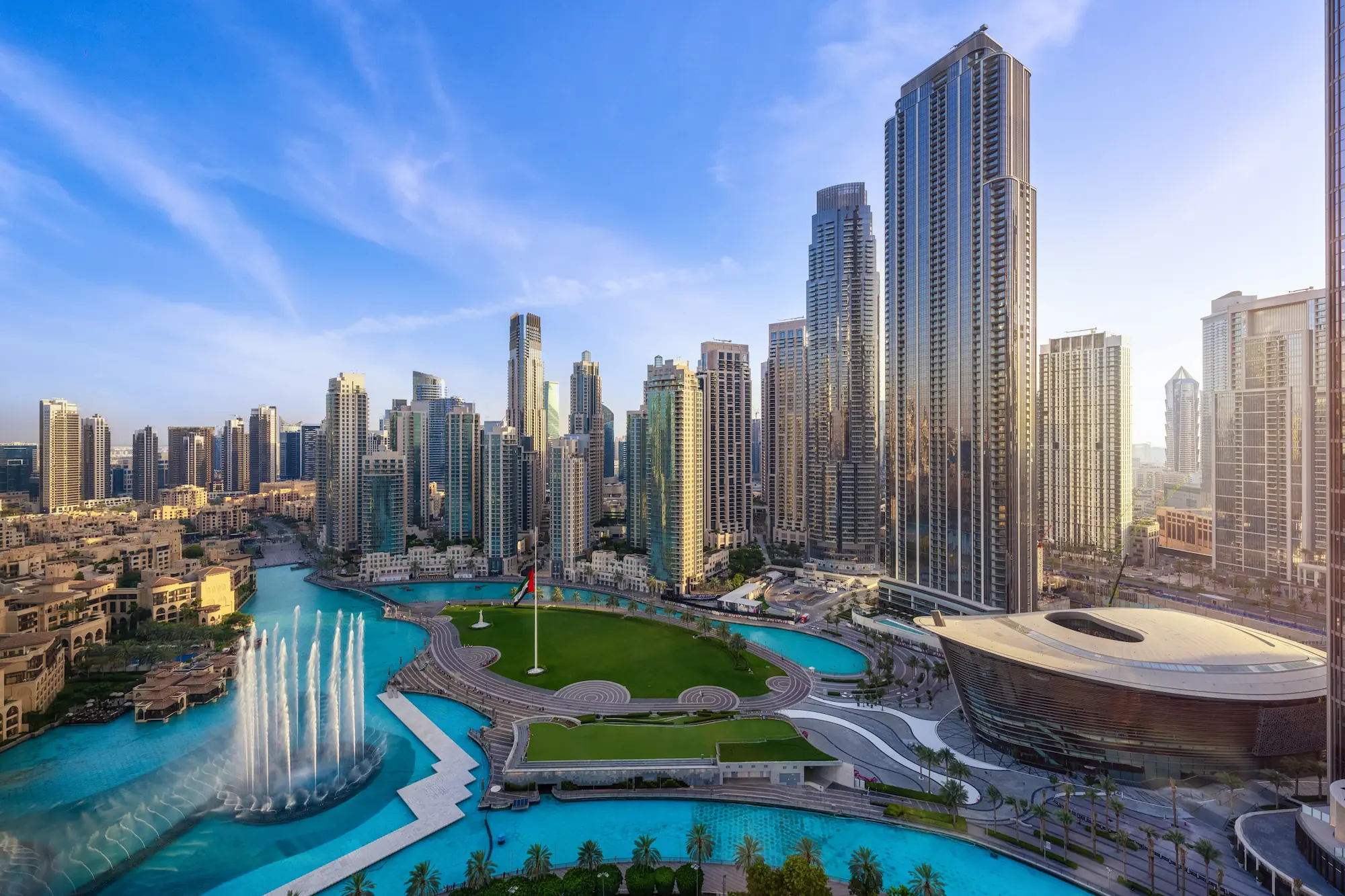
Downtown Dubai is Emaar’s masterpiece and the city’s most iconic skyline address. The Burj Khalifa, Dubai Mall, Fountain Street, and the Opera District make Downtown the undisputed tourism and business hub of the city. Property here carries the highest brand recognition globally, making it the first choice for international buyers who want a Dubai property that non-Dubai investors will immediately understand.
Gross yields average 6.0–6.8% for one and two-bedroom apartments, supported by constant short-term rental demand from tourists, business travellers, and event attendees (Dubai Mall alone receives over 80 million visitors annually). Capital appreciation has been strong — up 25–35% since 2021 for most product categories. Supply is constrained relative to demand, and Emaar’s active management of the community’s quality and brand premium provides long-term value protection.
4. Business Bay — The Yield Leader in a Central Location
Business Bay is consistently cited by data-driven investors as offering the best yield-to-price ratio in central Dubai. Positioned directly adjacent to Downtown with Dubai Canal views and metro access, Business Bay has rapidly matured from a corporate district into a high-demand residential address. One-bedroom apartments in quality buildings regularly achieve 7.5–8.5% gross yields, driven by corporate tenants, young professionals, and a strong short-term rental market.
Entry points for ready one-bedrooms start from AED 950,000–1.4 million, offering access to the Golden Visa threshold with room to spare. The off-plan pipeline in Business Bay remains strong, with several premium launches offering payment plans that allow investors to enter at effective prices 10–15% below equivalent ready inventory.
5. Dubai Hills Estate — The Family Community Standard
Dubai Hills Estate is Emaar’s flagship masterplanned community and the benchmark against which all other family-oriented communities are measured. Within the master plan: a world-class 18-hole golf course, Dubai Hills Mall, Mediclinic Hospital, multiple international schools, parks, and cycling tracks — all within a gated, well-managed community framework. The tenant profile is accordingly premium: senior expat families on multi-year lease commitments who treat the property with care.
Townhouses and villas at Dubai Hills have appreciated 30–40% since 2021 and rental demand consistently outstrips supply, particularly for four and five-bedroom villas. Long-term leases here are unusually stable — three-year tenancies from families anchored by school enrolments are common. For investors who prioritise capital preservation, tenant quality, and community infrastructure over maximum yield, Dubai Hills is the pre-eminent choice.
6. Jumeirah Village Circle (JVC) — The High-Yield Entry Point
JVC consistently records the highest gross rental yields in Dubai — averaging 8–9.5% for studios and one-bedroom apartments — making it the most popular community for first-time Dubai investors focused on income. Entry prices are the most accessible of any major Dubai community, with studios from AED 400,000–550,000 and one-bedrooms from AED 600,000–850,000.
The tenant base is Dubai’s largest demographic: young professionals, couples, and small families who want modern, clean, well-managed apartments at below-average rent. JVC’s connectivity has improved significantly with ongoing road infrastructure, and several Grade A developers including Ellington and Vincitore have launched premium products within the community, beginning to shift its positioning upmarket.
The Legal & Regulatory Framework
Dubai’s real estate market is among the most internationally accessible in the world, but it operates within a clear and strictly enforced regulatory framework designed to protect buyers, ensure market transparency, and prevent developer misconduct. The following are the non-negotiable legal realities every international buyer must understand.
Freehold Zones: Where You Can Buy
Foreign nationals can only purchase freehold property in designated zones approved and published by the Dubai Land Department. The list of freehold zones is extensive and covers all the communities that international buyers typically target: Dubai Marina, Palm Jumeirah, Downtown Dubai, Business Bay, DIFC, JVC, JBR, Jumeirah Lake Towers, Dubai Hills Estate, Arabian Ranches, Emirates Hills, and many others. Before making any offer, confirm that the property falls within a designated freehold zone — some residential communities in older parts of Dubai are leasehold-only for foreign buyers.
RERA’s Escrow Protection for Off-Plan Buyers
UAE law mandates that for every off-plan project, all buyer funds must be deposited into a RERA-registered escrow account. The escrow account is held by a licensed bank and funds are released to the developer only at verified construction completion milestones — foundation, structure, façade, handover — each independently certified by a RERA-approved inspection authority. This escrow structure is your primary legal protection against developer default. Verify the escrow account number through RERA’s online registry before signing any purchase agreement.
Transaction Costs: What to Budget
The Dubai Land Department charges a flat 4% transfer fee on every property transaction, calculated on the purchase price and payable at the time of Title Deed transfer. This is payable by the buyer. Additional costs include the agent’s commission (typically 2%, negotiable), DLD admin fees of approximately AED 4,000–6,000, and independent legal/conveyancing fees of AED 3,000–10,000 depending on complexity. Total transaction costs for most buyers sit at 4.5–6% of the purchase price. Budget for this separately from your purchase capital — it is not included in the property price.
Service Charges and Annual Holding Costs
Service charges in Dubai are set by RERA and vary significantly by community quality and developer. Rates range from AED 8–14 per square foot annually in mid-tier communities to AED 20–40 per square foot in premium developments with high-end amenity packages. For a 1,000 square foot apartment, this means AED 8,000–40,000 per year depending on building. Review RERA’s published service charge history for the specific building before purchasing — inflated or mismanaged service charges erode net yield significantly.
Your Exit Rights
There are no restrictions on reselling freehold property in Dubai. Foreign nationals can repatriate 100% of sale proceeds, including any capital gain, without restriction. There is no exit tax, no capital gains tax, and no requirement to reinvest within the UAE. The new buyer bears the 4% DLD transfer fee on purchase — your cost on exit is effectively zero beyond agent commission (if applicable). This clean, unrestricted exit is one of Dubai’s most significant competitive advantages over comparable emerging and frontier real estate markets.
Verified ROI Benchmarks by Property Type
The following data is based on 2024–2025 DLD transaction records and active rental market comparables across Dubai’s primary residential communities. Yields are gross figures. Net yields are typically 1.5–2% lower after service charges, management fees, and occasional vacancy periods.
| Property Type | Area | Entry Price | Gross Yield | 3-Year Capital Growth |
| Studio | JVC / Arjan | AED 450K–650K | 8.5% | 12–18% |
| 1BR Apartment | Dubai Marina | AED 1.2M–2.2M | 7.2% | 18–28% |
| 2BR Apartment | Downtown / Business Bay | AED 2.5M–5M | 6.4% | 22–32% |
| 3BR Townhouse | Dubai Hills | AED 3.5M–7M | 5.8% | 24–35% |
| 4–5BR Villa | Palm Jumeirah | AED 12M–35M | 5.2% | 38–50% |
| Branded Residence | Various Landmarks | AED 5M–25M+ | 4.8% | 30–55% |
Note: Branded residence figures represent a relatively small transaction sample and are more volatile. Capital appreciation ranges reflect 2021–2024 actual transaction data across secondary market sales. Short-term rental income can add 25–40% to gross yield figures for well-located, professionally managed units.
Frequently Asked Questions
The following questions represent the most searched queries from international buyers researching Dubai property investment. These are the questions that will come up — addressed here in full.
Q: Can foreigners buy property in Dubai without being a UAE resident?
Yes, and this is one of Dubai’s most significant advantages. Foreign nationals from any country can purchase freehold property in designated freehold zones without any UAE residency, visa, or prior connection to the country. The purchase can be completed remotely through a power of attorney, or in person at the DLD — typically in a single visit. There are no nationality restrictions, no pre-approval requirements, and no minimum prior UAE presence required.
Q: How much do I need to invest to qualify for the UAE Golden Visa?
The minimum investment for UAE Golden Visa eligibility through real estate is AED 2,000,000 — approximately $545,000 USD at current exchange rates. The property must be freehold, registered in your personal name, and fully paid (or at least 50% paid for off-plan projects). The visa is valid for 10 years, renewable, and extends to your spouse, children under 25, and domestic staff. There is no minimum annual stay requirement to maintain the visa.
Q: Is buying off-plan in Dubai safe for international investors?
Off-plan in Dubai is significantly safer than in most markets because UAE law mandates RERA-registered escrow accounts for all off-plan projects — buyer funds are only released to developers at verified construction milestones, not on demand. The primary remaining risks are construction delay and quality variation from specification. Both are substantially mitigated by selecting Grade A developers with documented delivery records (Emaar, Sobha, Meraas, Ellington), reading the SPA carefully for delay penalty clauses, and purchasing projects that are already 20–30% constructed.
Q: What are the total costs of buying property in Dubai?
Budget 4.5–6% of the purchase price for all transaction costs. This includes the 4% DLD transfer fee (the largest cost), agency commission of approximately 2% (typically negotiable on larger transactions), DLD admin fees of AED 4,000–6,000, and conveyancing or legal fees of AED 3,000–10,000. For off-plan purchases, the developer typically covers or reduces DLD fees as part of their sales incentive — negotiate this explicitly.
Q: Can I get a mortgage in Dubai as a non-resident foreigner?
Yes. Several UAE banks offer mortgage financing to non-resident foreign nationals, including Emirates NBD, Mashreq, ADCB, and HSBC UAE. Non-residents can access up to 50% loan-to-value (LTV) on properties below AED 5 million. Documentation requirements include 6–12 months of bank statements, proof of income, passport, and property details. Interest rates for non-residents currently range from 4.5–6.5% depending on fixed vs variable structure, bank, and term.
Q: Is there tax on rental income from Dubai property?
There is no rental income tax, no capital gains tax, and no property holding tax in the UAE. Your gross rental income is your net rental income from a UAE perspective. However, many countries — including the UK, Australia, Canada, and all EU states — tax worldwide income earned by their residents or citizens, regardless of where it originates. US citizens are taxed on worldwide income regardless of residency. Consult a qualified international tax advisor before investing — the UAE side is clean, but your home country obligations vary significantly.
Q: Which Dubai area gives the highest rental yield?
For gross yield, Jumeirah Village Circle, Arjan, International City, and Business Bay consistently deliver 7.5–9.5% on studio and one-bedroom apartments — the highest in Dubai. For the optimal balance of yield and liquidity (ease of resale when you exit), Dubai Marina, Downtown Dubai, and Business Bay are the strongest performers at 6.5–7.5% gross. For capital appreciation with lower yield tolerance, Palm Jumeirah, Jumeirah Bay Island, and Emirates Hills have delivered the most powerful 3–5 year appreciation cycles.
Q: How long does the Dubai property transaction take?
For ready secondary market properties, the full process from offer acceptance to Title Deed issuance typically takes 15–30 days — one of the fastest transaction timelines of any major real estate market. The steps are: MOU signing and 10% deposit (day 1), developer NOC application (3–10 days), and DLD Title Deed transfer (1–2 days once NOC is received). For off-plan purchases, the SPA is signed within 1–2 weeks of reservation, with the balance spread across construction milestones over the project’s delivery timeline.
Q: What happens to my investment if the Dubai market falls?
Dubai has experienced two significant corrections: post-2008 GFC (approximately 50% decline peak to trough) and post-2014 oil price fall (approximately 25%). Both were followed by full recoveries and subsequent new highs. The 2026 market is structurally more resilient: the buyer base is more diversified globally, regulation is far stronger (RERA escrow protections, DLD transparency, anti-money laundering controls), population growth is structural rather than speculative, and the government’s economic diversification away from oil dependency is well advanced. However, investors should plan for minimum 5–7 year horizons, avoid over-leveraging, focus capital in primary freehold zones with deep liquidity, and treat rental income as the return floor — not capital appreciation as the sole thesis.
Q: Should I buy ready property or off-plan in Dubai?
The right answer depends entirely on your objective. Off-plan advantages: lower entry price (typically 10–20% below equivalent ready inventory), flexible payment plans that reduce immediate capital deployment, potential capital appreciation between purchase and handover, and developer incentives including DLD fee waivers and post-handover payment plans. Ready property advantages: immediate rental income from day one, a tangible asset you can inspect before committing, no construction risk, and immediate mortgage eligibility. For investors who need current cash flow, buy ready. For investors with a 2–4 year patience horizon and surplus capital, a Grade A developer’s off-plan project in the right location typically outperforms on total return.
— CONCLUSION —
The Bottom Line for International Buyers in 2026
Dubai is not a speculative bet. It is a structurally sound, internationally open, tax-advantaged real estate market backed by genuine population growth, world-class infrastructure, and one of the most progressive property regulatory frameworks in the developing world.
But like every market, it rewards preparation and punishes improvisation. The buyers who outperform in Dubai are the ones who define their thesis clearly before searching listings, select their developer as rigorously as they select their asset, engage qualified local professionals, understand their legal rights and exit options, and hold through market cycles with the patience that prime real estate always ultimately rewards.
From $500,000 to $5,000,000 and beyond, the opportunity exists at every price point. The roadmap above gives you the framework to navigate it. The next step is yours.