by
by 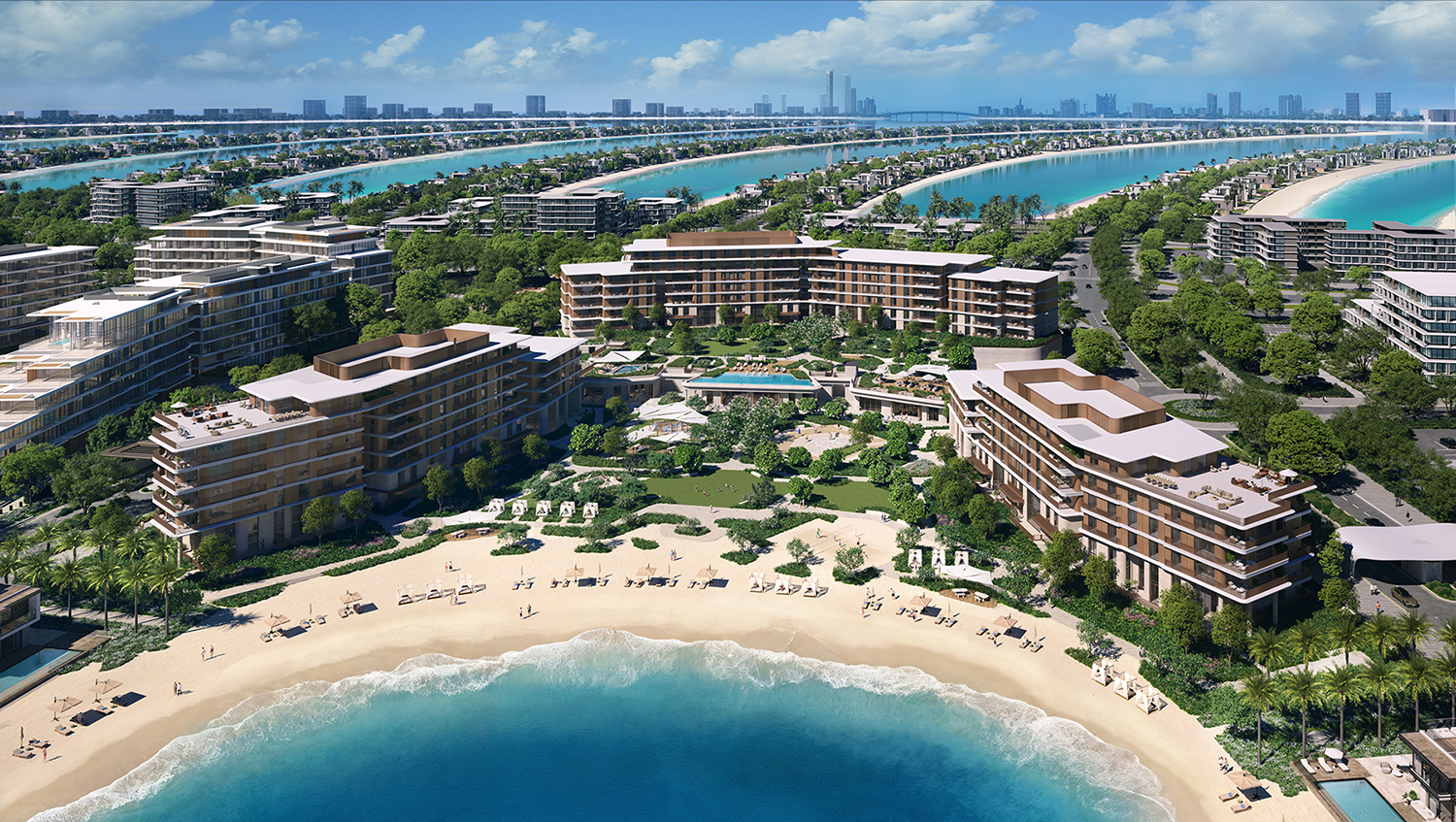
The developer’s latest release, spanning apartments from Dh2.7 million and townhouses from Dh14.9 million, lands as Palm Jebel Ali cements its place as the emirate’s most sought-after new waterfront address.
There was no grand reveal for this one. Nakheel has simply added another set of keys to a project that, since last autumn, has been doing something Dubai developers rarely commit to in writing: selling faster than expected. The 222 residences released this week form the next phase of Palm Central Private Residences, the apartment-and-townhouse heart of Palm Jebel Ali, and follow an opening tranche from October 2025 that the developer says cleared on strong demand.
The new homes are spread across three low- to mid-rise buildings: one- to four-bedroom apartments and four- to five-bedroom townhouses. Every residence is sold on the same promise: the sand begins where the building ends. Homes open directly onto the beach, frame the Arabian Gulf without interruption, and blur the line between indoor and outdoor space. In selected duplexes, living areas rise to double height, and terraces are sized to be lived on rather than glanced at from a doorway.
THE NUMBERS
What it costs to get in
Starting prices for the current release, per the developer’s published figures. Final pricing rises with floor, view and frond position.
| RESIDENCE | STARTING FROM |
| One-bedroom apartment | Dh2.7m (≈ $730,000) |
| Two-bedroom apartment | Dh4.3m |
| Three-bedroom apartment | Dh7.5m |
| Four-bedroom apartment | Dh12.4m |
| Townhouse · four to five bedrooms | Dh14.9m |
THE MASTERPLAN
An island built to be twice the first
The homes are almost a footnote to the ambition around them. Palm Jebel Ali is less a larger Palm Jumeirah than a different idea wearing the same silhouette: a mixed-use archipelago of resort islands, residential fronds, marinas and protected green space, with the crescent breakwater reserved for hotels and beach clubs rather than houses.
- 4 km: the length of the development, end to end
- 7 islands · 16 fronds: the geometry of the archipelago, with 90+ km of new coastline
- 35,000 families: the population it is designed to eventually house
- 80 hotels & resorts: planned across the destination, alongside a 9,000 m² retail centre
- Twice Palm Jumeirah: in scale; the headline comparison that frames every pitch
- 1,000 worshippers: at the Friday Mosque, designed by Skidmore, Owings & Merrill
THE MARKET BEHIND THE LAUNCH
Why the second palm now leads the first
The confidence behind this release is not invented. Across 2025, Palm Jebel Ali overtook Palm Jumeirah as Dubai’s single most active market for homes above Dh20 million: roughly 517 such deals, around Dh12.4 billion in value, and about a fifth of every ultra-luxury transaction in the emirate. For an island where most buyers cannot yet move in, that is a remarkable vote of capital.
Khalid Al Malik, CEO of Dubai Holding Real Estate, called the launch a new benchmark for beachfront living.
It sits inside a wider surge. Dubai’s total property transactions crossed Dh760 billion in 2025, a record, and the city logged more sales above $10 million than London or New York. The drivers are by now familiar: no income or capital-gains tax, a dirham pegged to the dollar, residency visas tied to property, and a thin supply of genuinely prime waterfront. Analysts who once called Dubai an emerging market increasingly describe it as an emerged one, with boom-and-bust giving way to structural depth. Notably, roughly two-thirds of 2025’s ultra-prime sales were off-plan: buyers are pricing the island Dubai is building, not the one it has already built.
THE OTHER SIDE OF THE LEDGER
What the brochure leaves out
A new-benchmark narrative is easy to write and harder to underwrite. The discount to Palm Jumeirah, where early per-square-foot pricing has run well below the established island, is the heart of the bull case and also its honest warning label. That gap is not free money; it is the market pricing real risk into an asset that will not deliver for years.
Three risks deserve naming. The first is timing: a two-to-three-year slip from stated targets is unremarkable for a megaproject of this scale, and Palm Jumeirah’s own difficult early years are the relevant precedent. The second is absorption: an island designed for 35,000 families must find them without compressing prices as supply lands. The third is the present climate: Dubai recorded its first quarterly residential price dip since 2020 in early 2026 amid regional tensions, and construction-cost inflation has been running sharply higher, pressure that megaproject schedules feel first.
None of this makes Palm Jebel Ali a poor buy. It makes it a bet, specifically on Nakheel’s ability to deliver at scale, on time enough, into a market that stays deep. Early buyers on Palm Jumeirah who held through its difficult opening were rewarded handsomely. They were also patient for a very long time.
THE BOTTOM LINE
A small chapter in a very large book
Dubai has spent a generation manufacturing coastline because the natural kind ran out, and Palm Jebel Ali is the largest expression of that habit yet: a second shoreline drawn into the Gulf and now, frond by frond, being sold. The 222 homes released this week are the chapter where the abstraction becomes addressable: a one-bedroom from Dh2.7 million, a townhouse from Dh14.9 million, and a 2030 date to start counting toward. Whether that proves to be early conviction or expensive patience is the only question that matters, and the one no launch event can answer.