by
by 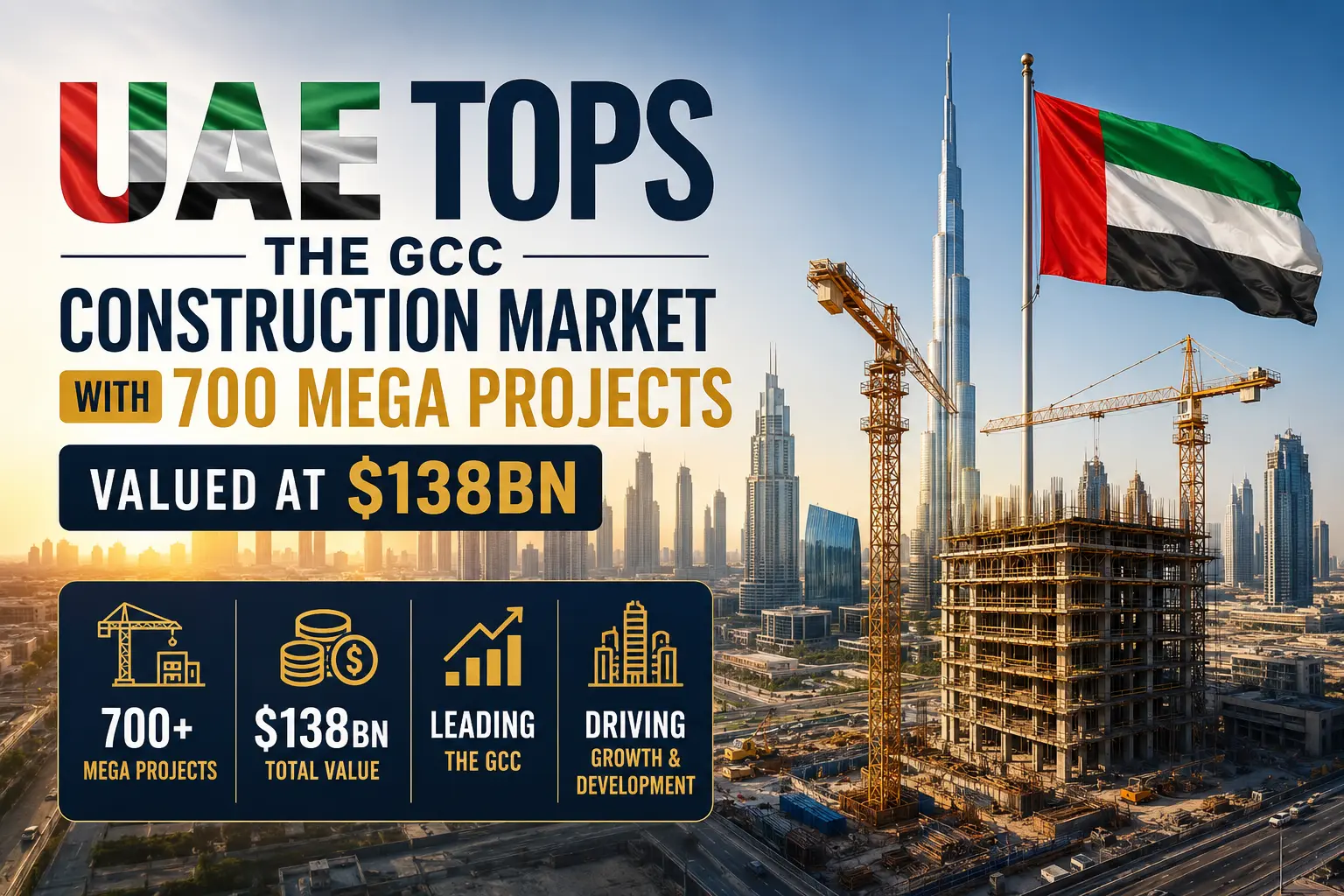
For most of the past decade, the story of Gulf construction was told in a single word: scale. Whoever poured the most concrete, tendered the largest packages and unveiled the most improbable renderings was assumed to be winning. A new report from the Abu Dhabi Chamber of Commerce and Industry (ADCCI) suggests that framing is now out of date, and that the UAE has stepped into the lead by a measure that scale alone cannot capture.
According to the chamber’s Abu Dhabi’s Construction Sector study, the second sectoral report issued under its 2025-2028 strategy, the UAE holds the region’s largest bank of confirmed, execution-ready work: roughly 700 projects valued at $138 billion, spanning real estate, energy, infrastructure and specialised industrial assets. Saudi Arabia sits close behind on project count with 628 confirmed schemes, while Oman forms a distinct second tier at 85 projects worth $19 billion.
On the surface, that reads like a clean UAE victory. The more interesting number is buried a layer down, and it points the other way.
01 THE TWO-LENS PROBLEM
Count says one thing. Committed value says another.
The report separates two ways of reading a market. The first is the confirmed pipeline: the sheer breadth of near-term, greenlit developments. On that lens, the UAE’s diversified base of mid-sized projects puts it first by volume.
The second lens is primary construction demand: the heavyweight core of major projects where the largest capital is actually committed. Measured this way, Saudi Arabia moves back ahead, with 78 major projects worth $89.5 billion against the UAE’s 129 projects worth $50.1 billion. In other words, the UAE spreads its bets across more, smaller undertakings; the Kingdom concentrates enormous value into fewer, larger ones. Neither is losing. They are simply building differently.
LENS 1 · CONFIRMED PIPELINE
| Market | Confirmed projects | Estimated value |
| UAE | 700 | $138bn |
| Saudi Arabia | 628 | $168bn |
| Oman | 85 | $19bn |
The UAE leads on volume of live work, even though Saudi Arabia’s pipeline carries the higher headline value.
LENS 2 · PRIMARY CONSTRUCTION DEMAND
| Market | Major projects | Value |
| Saudi Arabia | 78 | $89.5bn |
| UAE | 129 | $50.1bn |
Narrowing to the core of major projects, the ranking inverts: Saudi Arabia commits more capital into fewer, larger schemes, powered by its Vision 2030 giga-project portfolio.
02 FROM VOLUME TO VALUE
Abu Dhabi is trading concrete for systems
The headline count is only half of what ADCCI is arguing. The deeper claim is about what kind of construction now creates value in the emirate. Growth, the report says, is shifting away from traditional contracting and toward higher-value, engineered building systems.
In practice that means more work in engineered mechanical, electrical and plumbing (MEP) systems, modular and prefabricated methods, digital delivery platforms, and AI-enabled tools aimed at squeezing waste and risk out of project timelines. The prize is no longer just putting up structures faster. It is certainty that they will be delivered on time, to spec, and with predictable lifecycle performance.
“Value today comes from integration, quality and certainty of delivery, not just scale.”
ALI MOHAMED AL MARZOOQI · DIRECTOR GENERAL, ADCCI
Al Marzooqi frames rising private-sector participation as a vote of confidence in that model, and as the engine behind Abu Dhabi’s ambition to become a hub for advanced construction and manufacturing rather than a buyer of imported expertise. The report casts this as a move from a project-based market to a programme-driven one, where faster digital permitting, standardised government contracting, industrial-land incentives and tougher sustainability rules combine to make demand steadier and more predictable.
THE GROWTH SIGNALS
| 38,600 | Active construction licences in Abu Dhabi, February 2026 |
| +66% | Year-on-year rise in new business registrations during 2025 |
| +24.8% | Growth in the number of active construction memberships |
| ~28% | Compound annual growth rate of new memberships, 2019 to 2025 |
The chamber also sees the shift opening export lanes across the supply chain, from raw materials through to manufactured components the Gulf has historically imported. Its Export Potential Index points contractors and manufacturers toward the specialised, higher-margin products regional projects increasingly demand: ductwork, valves, switchgear, power distribution systems, integrated MEP packages and prefabricated modules.
03 THE WIDER BOARD
Two giants, one region, and a market recalibrating
Zoom out and the ADCCI figures fit a bigger picture. Mordor Intelligence values the GCC construction market at around $175 billion in 2025, rising toward $182 billion in 2026 and an estimated $222 billion by 2031. It is a steady climb underpinned less by oil price swings than by long-dated national programmes: Saudi Vision 2030, Dubai’s 2040 Urban Master Plan and Plan Abu Dhabi 2030 among them.
That resilience is real, but 2026 is also a recalibration year. Industry analysts note that regional contract awards cooled by roughly a fifth in 2025 after an exceptional 2024, when a wave of Saudi giga-project packages hit the market at once. The pullback reads less as a downturn than as a portfolio maturing, with projects moving from tendering into execution. The UAE, for its part, still logged around $124 billion in contract awards over 2025, keeping it firmly among the region’s most active markets.
Saudi Arabia’s answer is scale on a different order entirely. Its national pipeline, anchored by NEOM, Qiddiya, the Red Sea developments and a dense programme of transport, housing and utilities work, ranks among the largest on the planet, and a run of fixed global deadlines is now pulling it forward.
FIXED DEADLINES ON THE HORIZON
| 2030 | Riyadh Expo 2030 An immovable deadline accelerating venue and enabling infrastructure delivery across the Saudi capital. |
| 2034 | FIFA World Cup Stadiums, transit and hospitality capacity that must be delivered on a fixed calendar. Hard to slip, hard to descope. |
| 2030s | 3D-printed building mandates Dubai targets a quarter of new buildings to use 3D-printing methods, backed by expedited permitting, a signal of where UAE demand is heading. |
04 THE CATCH
Costs are climbing while the market gets choosier
None of this unfolds in a vacuum. Input costs have been rising into 2026, with benchmarking data pointing to rebar creeping up since late 2025 and sharper moves in oil and aluminium-linked indices. Consultants describe a market absorbing genuine, persistent cost pressure, yet one still very much able to execute. The takeaway from most analysts is rigour rather than retreat: developers who price against current, precise benchmarks will protect project viability as conditions shift.
That pressure dovetails neatly with the ADCCI thesis. When materials and financing cost more, the premium on efficiency, integration and delivery certainty rises with them, and the engineered, systems-led model the report champions starts to look less like a nice-to-have and more like the only sustainable way to build at Gulf scale.
05 THE READ
What the numbers are really saying
Strip away the league-table framing and the report describes a region moving in the same direction at different speeds. Both leading markets are shifting toward fewer, more advanced, more tightly integrated projects, in energy, utilities, infrastructure and industrial facilities, that reward precision over sheer output.
The UAE’s advantage, on ADCCI’s telling, is breadth and readiness: a deep, diversified pipeline, a maturing local industrial base, and regulation nudging the whole ecosystem toward higher-value work. Saudi Arabia’s is concentrated firepower. For contractors, suppliers and investors, the practical message is the same regardless of which lens they favour: the Gulf is no longer buying scale for its own sake. It is buying certainty. And the firms that can guarantee it are the ones this next cycle will reward.