by
by 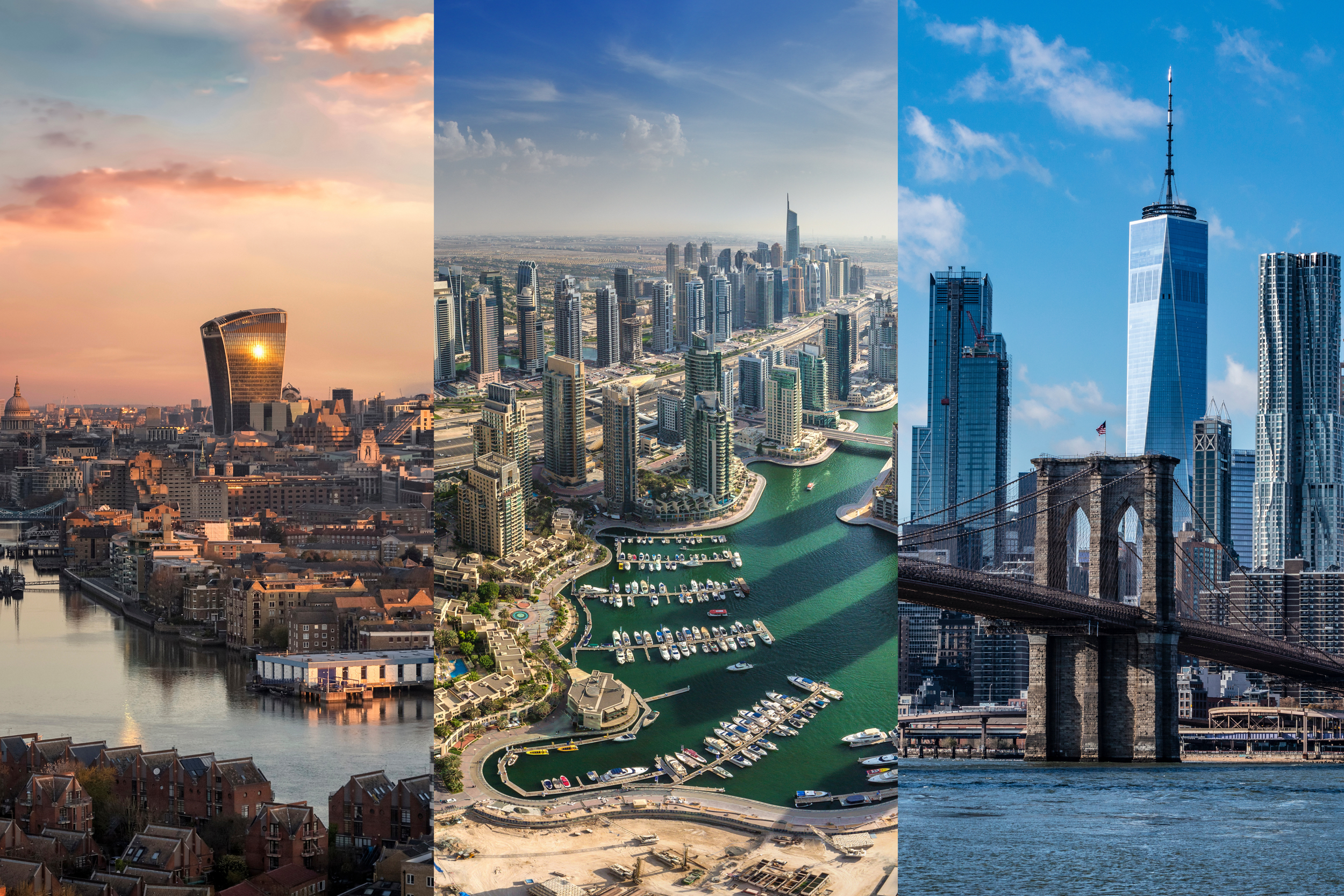
Consider two data points, filed within weeks of each other. In Dubai, Emaar has already sold 99.1% of its 9,085 residential units scheduled for handover in 2026. Meraas has sold 99.77% of its 2,615. Dubai Holding and Meydan are fully sold out. Across the full off-plan pipeline running through 2029, buyers have absorbed 71.45% of the city’s inventory, according to a market analysis by fäm Properties.
In London, the opposite dynamic has taken hold. Savills, Knight Frank and Hamptons all revised their 2026 London price forecasts downward in late 2025, citing weaker buyer sentiment, elevated stamp duty and the 2025 scrapping of non-dom rules that had drawn international capital to the prime segment, as reported by Country Life. Zoopla reports asking-price discounts now averaging around 3.8% and marketing periods running meaningfully longer than they did in the 2021-22 boom.
Same quarter. Same class of international investor. Entirely different gravity.
That contrast is the story of global real estate in 2026. Something quietly came apart in 2025, and by the time the Q1 2026 data landed, the pattern was unmissable: the world’s big property markets had stopped moving together. London, New York, Dubai and the major Chinese cities are now running on four different clocks. For the first time in a long time, the differences matter more than the similarities.
Dubai: the new-buyer market
Start with the obvious one. Dubai in 2026 is not the Dubai of 2013, or 2021, or even 2023. The speculators who defined earlier cycles have been mostly priced out, replaced by people who want to live in, rent out, or deploy long capital through the buildings they buy.
The scale is genuinely startling. According to Dubai Land Department figures compiled by DXB Interact and Global Property Guide, the emirate recorded around 205,100 residential sales transactions in 2025, up more than 18% on 2024. Total residential transaction value hit AED 539.9 billion, a 24.7% jump. Q1 2026 kept the pace at AED 176.7 billion, up 23.4% year on year, with January alone setting an all-time monthly record of AED 72.4 billion.
| AED 539.9B Dubai residential transaction value in 2025, up 24.7% year on year (DLD / DXB Interact) | 205,100 residential transactions recorded in Dubai in 2025 |
| ~7% average gross apartment rental yield at year-end 2025 (Engel & Völkers) | 120,000 new residential units forecast for handover in Dubai in 2026 (Fitch Ratings) |
But the number that matters more is 120,000. That is the volume of new residential units Fitch Ratings expects to be handed over in Dubai this year, more than triple the 35,000 that landed in 2025. Cushman & Wakefield Core’s head of research, Prathyusha Gurrapu, expects price appreciation to cool to 5 to 8% this year, down from the 12 to 22% of 2024 and 2025. Fitch has gone slightly further, flagging the possibility of localised corrections in specific submarkets.
If that sounds bearish, read it again. It isn’t. It is the sound of a market growing up. Knight Frank’s regional head of residential, Will McKintosh, describes the shift as a move from speculation to structural depth: a market powered by end-users and long-duration capital rather than the next flip. That is what you want. It is what London had in the 1990s before it started coasting.
London: the velvet-rope market
If Dubai in 2026 is a crowded conveyor belt, London is the doorman at the upstairs club. Elegant. Unbothered. Moving at its own pace. Not especially interested in your story.
Knight Frank’s downgrade in late 2025 pulled its Greater London forecast below the UK national average, with prime central London adjusted further still on the back of the non-dom rule changes. Savills now projects London prices broadly flat in 2026, with cumulative growth of about 13.6% out to 2030, per analysis via Investropa. The average Greater London property sits around £547,000. Citywide net rental yields, after service charges and management, land at roughly 3.4% per Investropa’s breakdown of ONS and UK House Price Index data.
Outer boroughs (Barking and Dagenham, Walthamstow, Croydon) can still deliver gross yields of 5.5 to 7%. But the headline number hides a lot. There is stamp duty, a 5% surcharge on additional properties, capital gains tax on the exit, rising service charges on flats, and the operational friction the Renters’ Rights Act introduces from May 2026.
Translation: London is where money goes to stop moving. It is a preservation market, not a wealth-creation one. What you get in exchange for the low yield is extraordinary liquidity, institutional depth, and the comfort of owning an asset whose title has been defended by centuries of common-law precedent. That is real value. It is simply a different kind of value from what Dubai is offering.
New York: the vault
Manhattan operates on an even more extreme version of London’s logic. Gross rental yields on Manhattan condominiums typically land between 2 and 3% after common charges and property taxes, according to market analysis published by Castle Avenue’s Wei Min Tan, who tracks the segment for global investors.
Two to three percent. And global buyers are still lining up. Why?
Because they are not buying for yield. They are buying for scarcity (only about 10% of Manhattan housing stock is condominium), for low vacancy (around 2.7%), for tenants who earn forty times the monthly rent, and for a twenty-six-year track record of roughly 6% annual appreciation. New York is not a rental income market. It is a safety deposit box with a view. For the global capital that treats it that way, the arithmetic works.
The catch, which the specialist brokers will tell you quietly, is US estate tax exposure. For a non-resident foreign buyer who dies owning New York property in their own name, the tax bite can run to up to roughly half the asset’s value, depending on structure and treaty relief. It is solvable through the right ownership vehicle. It just means the real transaction cost in New York is not the broker fee. It is the lawyer who sets the whole thing up.
Shanghai and the slow winter
At the other end of the spectrum sits China, where the story continues to be one of patient deterioration. S&P Global Ratings cut its outlook on the country’s primary property market in February, now expecting sales to fall 10 to 14% in 2026. That is significantly worse than the 5 to 8% drop the same analysts were modelling just four months earlier. Prices could fall another 2 to 4% on top of similar declines during 2025.
A late-2025 Reuters poll of property analysts projected home prices falling 2.8% in 2026 and flatlining in 2027, markedly darker than the same poll twelve months earlier. Even Beijing, Guangzhou and Shenzhen, once viewed as healthy tier-one anchors, recorded declines of at least 3% in 2025. Only Shanghai held up.
The deeper issue is not the prices themselves. It is what falling prices do to household balance sheets. Residential property has historically accounted for something like 70% of urban Chinese household assets. When that asset falls for four years running, people spend less, save more, and wait. Chinese bank deposits have roughly doubled over the past five years. That is not a recovery pattern. That is convalescence.
Dubai and Shanghai are, in a real sense, running opposite clocks. One is absorbing new residents and channelling capital into property. The other is waiting for confidence to come back.
What 9% yield actually looks like
This is where Dubai’s numbers get unusually specific. Bayut’s 2025 Dubai Property Market Report, as covered by Khaleej Times, found that affordable apartments in communities such as International City, Dubai Investments Park and Discovery Gardens delivered gross rental yields of roughly 9 to 10%. Mid-market areas like Town Square and Al Furjan landed in the 7 to 9% range.
Those numbers carry real texture. The highest affordable-segment yields reflect older buildings with higher tenant turnover and lower purchase prices, not a free lunch. Investors underwriting 9% need to account for vacancy risk and maintenance drag. But even adjusted for that, the underlying arithmetic has no direct equivalent in any tier-one Western city.
| MARKET | GROSS RENTAL YIELD | 2026 PRICE OUTLOOK | PROPERTY TAX |
| Dubai (apartments) | ~6 to 7% | +5 to +8% | None |
| Dubai (affordable) | ~9 to 10% | Segment-dependent | None |
| London (citywide) | ~4 to 5% gross | 0 to +2.5% | Council tax + 5% BTL surcharge |
| Manhattan | ~2 to 3% net | Stable / slow growth | High property + common charges |
| Tier-1 China | ~1.5 to 2.5% | −2 to −4% | Variable; policy-driven |
Layer on top of those yields the structural advantages that nobody in London or New York can offer: zero annual property tax, zero capital gains tax on residential sales, zero tax on rental income, full foreign freehold ownership in designated zones, a dirham pegged to the US dollar, and eligibility for long-term Golden Visas on qualifying investments. The gap between Dubai’s net return and London’s net return isn’t marginal. It is structural.
That is why, even as growth moderates, foreign capital keeps flowing in. What investors are buying is not the next Dubai boom. They are buying the ongoing return profile that the mature markets can no longer deliver.
“The old investor question of where in the world to buy property has quietly been replaced by a better one: which cycle am I trying to be exposed to?”
The thing you shouldn’t ignore
Before anyone gets carried away, the 120,000-unit supply wave is real, and it will not hit evenly. The most exposed segment is mid-market apartments in communities scheduled to absorb heavy concentrated handovers in late 2026 and 2027. Jumeirah Village Circle is a case in point: an investor buying there expecting an immediate 9% yield could find herself competing for the same tenant pool against hundreds of newly-delivered units. That is a very different conversation from the one Chinese developers are having. But it is the conversation Dubai buyers need to be having in 2026.
Villas, prime waterfront, branded residences and established master-planned communities are expected to continue outperforming, according to the consensus of Knight Frank, Cushman & Wakefield Core, Cavendish Maxwell and Bayut. The generic rising-tide trade is over. Location, developer and segment selection are back in charge.
Which cycle do you actually need to own?
The honest takeaway from 2026 so far is this. The old investor question of where in the world to buy property has quietly been replaced by a better one: which cycle am I trying to be exposed to?
If the goal is yield and net cash flow, Dubai is doing something, particularly in its affordable and mid-market layers, that no mature Western city can currently match. If the goal is wealth preservation and currency diversification, London and New York remain among the handful of places on earth where an institutional buyer will take your asset off you at 3 a.m. on a Tuesday. If the goal is a contrarian recovery bet with a decade-long horizon, China becomes interesting. Cautiously.
The mistake is treating these as interchangeable. They aren’t. They are priced in different cycles, shaped by different demographics, and governed by entirely different rules. Owning one of each in unequal weights is probably smarter than owning all four evenly.
The bottom line
Global real estate has split into two camps: markets that preserve wealth and markets that still create it. London and New York stay firmly in the first. China is working through a deeper adjustment than most want to admit. And Dubai, despite the moderation, remains in the second, with the essential caveat that 2026 will reward precision far more than momentum.
For investors seriously evaluating entry into the UAE this year, the 2023-to-2024 approach (pick any off-plan launch, wait, profit) is no longer available. What works now is working with a RERA-registered brokerage that can model yields against the 2026 supply pipeline, flag communities with genuine absorption capacity, and structure purchases around Golden Visa and tax advantages. Binayah Properties, active in the Dubai market since 2007 and registered under Dubai’s Real Estate Regulatory Agency, is among the established brokerages working with investors at that level across freehold communities, off-plan launches and completed assets.
Either way, 2026 is not the year to try to predict which market wins. It is the year to understand why each one is doing what it is doing, and to buy into the cycle that matches the return you actually need.
Frequently asked questions
Is Dubai real estate still a good investment in 2026?
Yes, but with a sharper eye than a year ago. Gross apartment yields still average around 6 to 7% per Global Property Guide and Engel & Völkers, roughly double what London and New York offer. Cushman & Wakefield expects capital growth to moderate to 5 to 8%, down from the 12 to 22% of 2024 to 2025. Expect steady returns, not another runaway year.
How does Dubai really compare with London for property investment?
Dubai apartment gross yields are roughly double London’s citywide average of 4 to 5%. London also carries stamp duty surcharges, capital gains tax, and rising service charges that compress the net return further. Savills projects London prices broadly flat in 2026 with cumulative growth of about 13.6% out to 2030: solid preservation, limited upside.
Can foreigners buy property in Dubai?
Yes. Foreign nationals can purchase freehold property in designated zones across Dubai with 100% ownership rights. Qualifying investments can also support eligibility for the UAE’s long-term Golden Visa.
What is the average rental yield in Dubai right now?
Around 7% gross for apartments and closer to 5% for villas at year-end 2025, per Engel & Völkers and Global Property Guide. But yields are not uniform. Bayut data shows affordable communities like International City and Discovery Gardens producing 9 to 10%, though these higher yields reflect older buildings with higher tenant turnover and should be underwritten accordingly.
Off-plan or ready: which is smarter in 2026?
Off-plan still offers lower entry prices and staggered payments, but with 120,000 units scheduled for handover in 2026 per Fitch Ratings, the bigger question is location and developer quality. Ready property gives you immediate rental income and avoids delivery risk. Neither is categorically better. The answer depends on your time horizon and risk tolerance.